

Competitive advantage is the reason customers choose one business over the alternatives.
It is created when a company delivers value in a way that is meaningful to customers and difficult for competitors to reproduce. That advantage may come from specialist knowledge, trusted relationships, an efficient process, unique technology, exceptional service, lower cost or a strong reputation.
However, being different is not enough. The difference must matter to the customer.
Competitive Advantage Versus a Marketing Claim
Many businesses describe themselves as professional, experienced, innovative or customer-focused. These qualities may be important, but they are rarely enough to create a genuine competitive advantage because competitors can make the same claims.
A strong advantage is more specific and supported by evidence.
For example:
- A consultancy may have a proven methodology that helps clients reach decisions faster.
- A law firm may combine specialist expertise with a clear, supportive client process.
- A manufacturer may deliver customised products in significantly less time than the industry norm.
- A service business may understand one sector more deeply than generalist competitors.
The advantage becomes credible when customers can see how it improves their experience or outcome.
Common Sources of Competitive Advantage
Specialist expertise
A business that understands a defined customer, sector or problem can often provide more relevant advice and better solutions than a generalist.
Specialisation can also strengthen content and search visibility because the company can build deeper authority around a focused subject.
Customer experience
How a business communicates, responds and supports customers can be a meaningful differentiator. A well-designed experience may reduce uncertainty, save time and build trust.
Operational efficiency
Strong systems can allow a company to deliver faster, more consistently or at a lower cost. The process behind the service may be as important as the service itself.
Intellectual property or technology
Proprietary tools, data, products or methods can create an advantage when they deliver a result competitors cannot easily match.
Reputation and trust
In sectors where the customer is making an important or high-risk decision, reputation can be decisive. Reviews, recommendations, visible expertise and consistent information all help reduce perceived risk.
Relationships and access
Long-standing partnerships, networks or distribution channels can give a business reach and insight that competitors may struggle to develop.
How to Identify Your Competitive Advantage
Start with the customer rather than the company.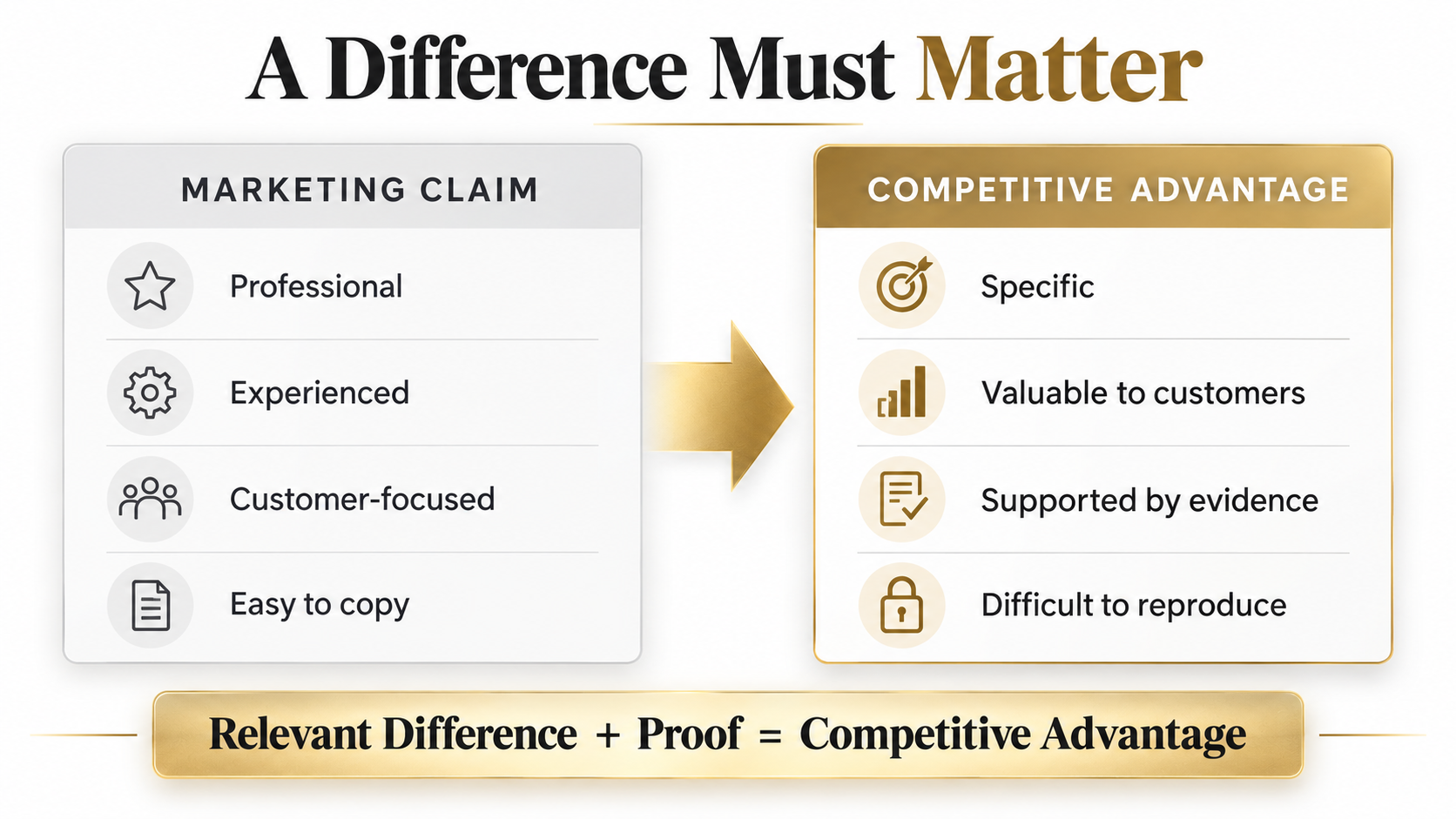
Ask:
- Why do our best customers choose us?
- What do they value most about working with us?
- What problem do we solve particularly well?
- Where do we consistently outperform alternatives?
- What capabilities have we developed over time?
- Which parts of our approach would be difficult to copy?
- What evidence supports our claims?
Customer interviews, reviews, sales conversations and lost-opportunity feedback can reveal patterns that internal discussions miss.
It is also useful to review competitors. The aim is not to imitate their messaging. It is to understand the choices customers see and identify where your business can occupy a clearer position.
Communicating Your Advantage
A competitive advantage has limited value if customers cannot recognise it.
Your website, content, case studies, proposals, social profiles and sales conversations should communicate a consistent reason to choose the business. Claims should be supported with proof such as results, client experiences, credentials, original insights or a transparent process.
This clarity also matters for online and AI-assisted discovery. Search engines and AI tools rely on consistent, credible information to understand what a business does and where it has authority. Vague claims make the company harder for both people and technology to evaluate.
Protecting Your Position
Competitive advantage is not permanent. Customer expectations change, competitors improve and technology makes some capabilities easier to copy.
Businesses need to keep strengthening the systems, expertise and relationships behind their position. They should also monitor whether the advantage continues to matter to customers.
The best advantage is usually built through a combination of strengths rather than one isolated feature. Specialist knowledge supported by an excellent process, a strong reputation and clear communication is much harder to replicate than a single claim.
Make the Difference Clear
Customers should not have to search through several pages to understand why your business is the right fit.
At Strategic Results Marketing, we help businesses clarify their positioning and turn genuine strengths into credible marketing messages. When your competitive advantage is clear, your marketing becomes more focused and the right customers can make decisions with greater confidence.
Related Resources
- What Is Business Strategy? – Learn how competitive advantage supports the wider direction of a business.
- What Is Marketing Strategy? – See how positioning and differentiation shape effective marketing.
- What Is Strategic Planning? – Understand how businesses choose and act on strategic priorities.
- What Are KPIs (Key Performance Indicators)? – Identify measures that show whether your market position is producing results.