
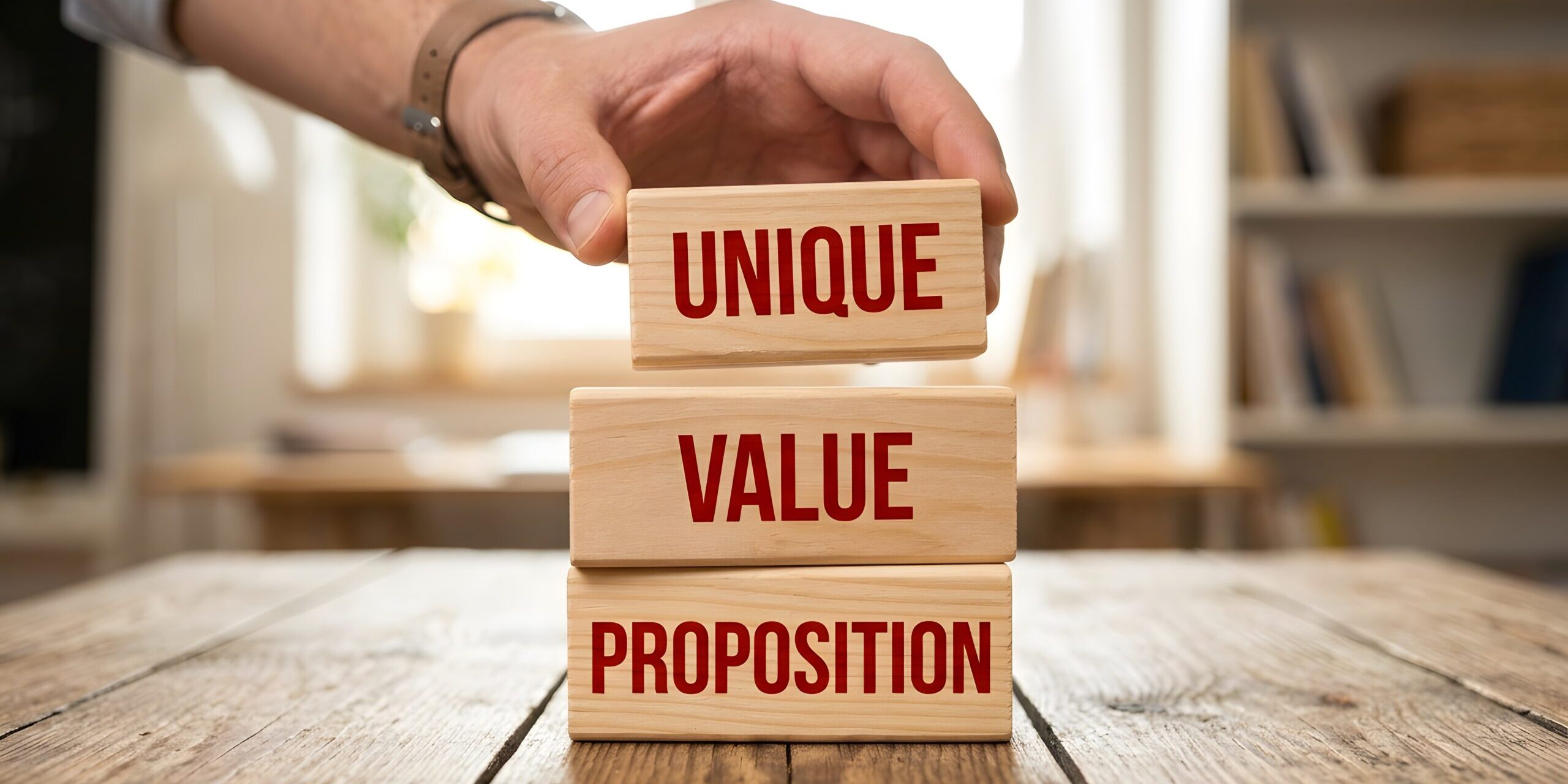
If a stranger asked, “Why should I choose you?”, could you answer in one clear sentence? That answer is your value proposition.
A value proposition is a clear explanation of why someone should choose your business. It is the heart of your brand identity and the starting point for your tagline. When it is strong, marketing gets easier, because people understand quickly whether you are right for them.
What a value proposition is, and what it is not
A value proposition is a specific promise of value to a defined customer. It explains what you do, who it is for, what changes for them and why they should choose you over the alternatives.
It is not a list of services, a mission statement or a tagline. It is also not a vague claim such as “we deliver excellence,” which tells a customer nothing they can use to decide.
Value proposition, tagline, USP and mission: what is the difference?
- Value proposition: the full explanation of why someone should choose you.
- Tagline: the short, memorable version of the idea. See our guide to the tagline.
- Unique selling proposition (USP): the specific feature or advantage that sets you apart. It is often one part of a value proposition.
- Mission: why your business exists, usually written for internal use.
The four parts of a strong value proposition
- Who. A clearly defined customer, not “everyone.”
- Need. The problem they face or the result they want.
- Outcome. What changes for them when they work with you.
- Difference and proof. Why you rather than the alternatives, and the evidence behind it.
A simple formula
Use this template to draft your first version:
We help [who] achieve [what] so they can [outcome], unlike [alternative], because [what makes you different].
Here are three fictional examples to show it in action:
- Bookkeeper: “We help small service businesses keep their finances organised so they can make confident decisions, unlike do-it-yourself spreadsheets, because every client gets a dedicated bookkeeper and a monthly plain-English summary.”
- Dental practice: “We help busy families keep their teeth healthy with evening and Saturday appointments, so dental care never means missing work or school, unlike clinics that only open during office hours, because every visit ends with a clear treatment plan in everyday language.”
- Landscaping company: “We help homeowners who lack time for upkeep enjoy a tidy garden all season, unlike one-off crews that come and go, because each client has a named crew lead and a seasonal care plan.”
Once you have a draft, trim it. The formula is a thinking tool. Your final version should read like natural speech.
How to find your value proposition
- Talk to customers. Ask why they chose you, what problem they had, what nearly stopped them and what they would tell a friend.
- Read your reviews. Look for repeated phrases. The words customers use are often better than the words you would choose.
- Study your competitors. Notice how similar businesses describe themselves, and look for gaps they leave open.
- List strengths you can prove. Choose those backed by evidence, such as response times, guarantees, results or credentials.
- Draft and refine. Use the formula, then remove jargon and filler.
- Connect it to your pillars. Your brand pillars show how you consistently deliver on the promise.
What makes a value proposition strong
- Specific. It names the customer and the benefit.
- Believable. It is backed by something you actually do.
- Different. It says something your competitors do not.
- Clear. It can be understood in about five seconds.
- Customer-focused. It talks about the customer’s result, not your achievements.
- Consistent. It is told the same way wherever people meet your business.
Where to use your value proposition
- Your homepage headline and the paragraph beneath it
- Your About page
- Google Business Profile and directory descriptions
- Social media bios and LinkedIn pages
- Proposals, quotes and sales conversations
- Email signatures and landing pages
- Advertising copy
When the same promise appears everywhere, customers get a consistent message, and so do the search tools that summarise businesses online. Use your brand voice to phrase it in a way that sounds like you.
How to test your value proposition
- The five-second test. Show your homepage to someone for five seconds, then ask what you do and who it is for.
- The customer echo. Do customers repeat your words when they describe you?
- The swap test. Replace your name with a competitor’s. If the statement is still true, it is too generic.
- The proof check. Can you point to evidence for every claim?
- The enquiry check. Over time, notice whether the enquiries you receive match the customers you want.
Common value proposition mistakes
- Talking about yourself. “We are a leading provider” describes you, not the benefit to the customer.
- Using jargon. If your customer would not say it, do not write it.
- Making generic claims. “Quality service at competitive prices” could describe any business.
- Trying to speak to everyone. A proposition for all customers usually connects with none.
- Offering no proof. A claim without evidence is just marketing talk.
- Never revisiting it. As your services and audience change, your proposition should too.
Frequently asked questions
How long should a value proposition be? The core version should be one or two sentences. You can expand it into a short paragraph for your homepage or sales materials.
Can I have more than one value proposition? You can have a main one for the business and tailored versions for specific services or audiences, as long as they stay consistent with each other.
How is a value proposition different from a tagline? The value proposition explains your promise in full. The tagline is the short, memorable line that points to it.
Where to go next
Your value proposition is built on your brand pillars, shortened into your tagline and expressed through your brand voice. Together they form your brand identity.
Not sure your message is landing? Contact us or browse the Marketing Terms Glossar