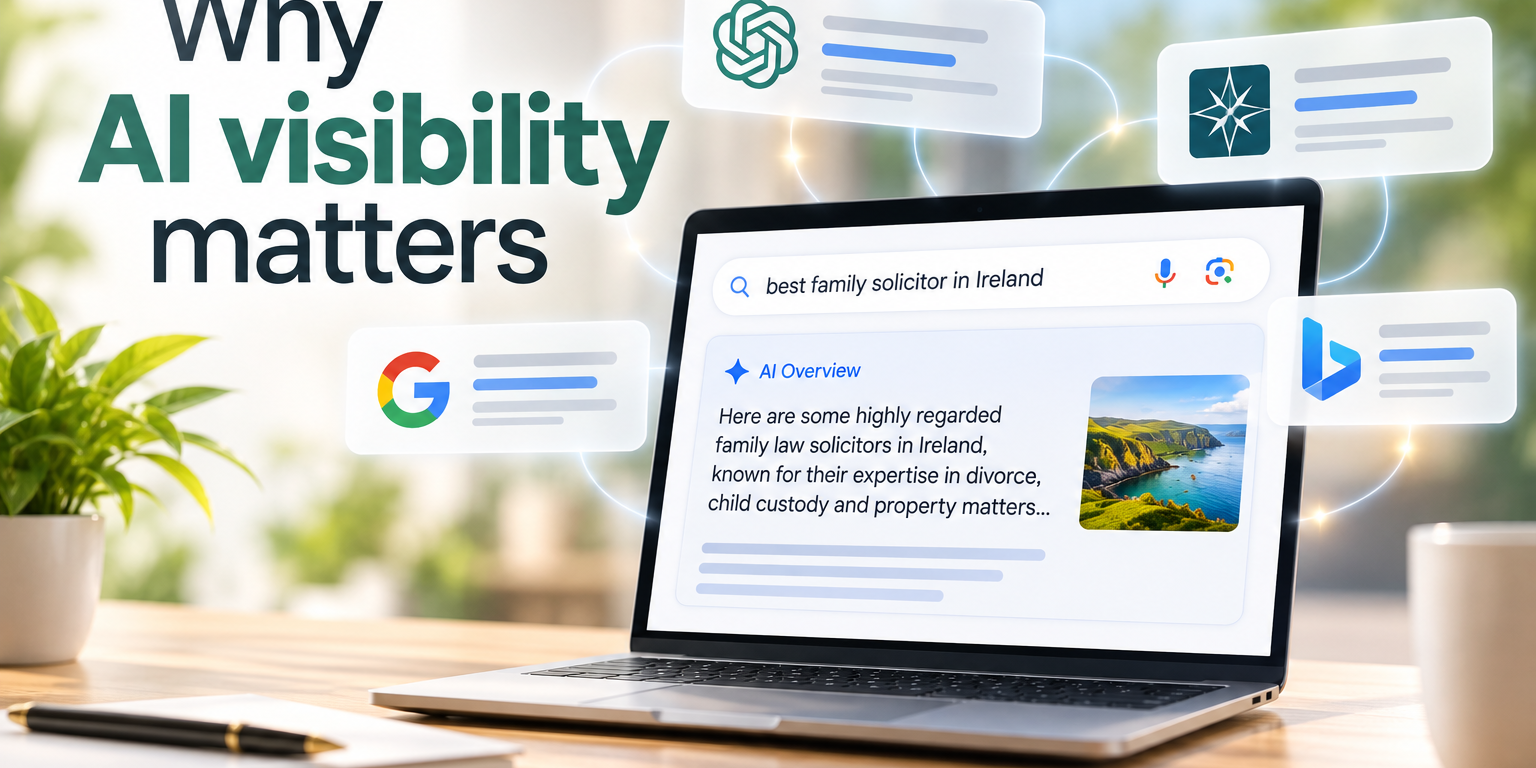
When someone asks an AI tool, “Who is a good accountant near me?” or “What should I look for in a web designer?”, does your business appear in the answer? And if it does, is the description accurate? That is AI visibility.
AI visibility is how often, and how accurately, your business is mentioned, described or recommended in answers produced by AI tools. It is the AI-era counterpart to being found on a search results page.
For small businesses, this is quickly becoming part of everyday reputation. Customers may check an AI assistant before they check your website, and what it says can shape whether they ever contact you.
Why AI visibility matters
- Shortlists form inside the answer. If competitors are named and you are not, you may not be considered.
- Accuracy affects trust. An AI tool that describes the wrong services, location or pricing can send people elsewhere.
- It reflects your wider reputation. AI answers draw on reviews, listings, articles and your website, so they often show how consistent your presence is.
- Customers arrive better informed. People who have already read an AI summary of your business expect your website to confirm it.
What AI visibility is, and what it is not
- It is not a ranking. There is no single list with positions. Answers vary by tool, question and even by moment.
- It is not guaranteed. Nobody can promise that an AI tool will mention your business.
- It is not only about being named. The context and accuracy of the description matter as much as the mention.
- It is not separate from SEO. Strong foundations help both. SEO still matters, and AI visibility extends it.
What influences AI visibility
Platforms do not publish their formulas, so no one can give you a perfect checklist. But several factors appear again and again in how these tools find and describe businesses:
- Clear, helpful content that answers real customer questions in plain language
- Consistent business information across your website, Google Business Profile, directories and social profiles
- Reputation signals, especially recent, genuine reviews and how you respond to them
- Credible mentions elsewhere, such as industry directories, local press, partner websites and professional associations
- Demonstrated expertise, including named authors, qualifications, case studies and original insight
- A well-structured website with clear service pages and logical headings
- Technical accessibility, so important pages can be crawled and read
- Freshness, meaning information that is kept up to date
How to check your AI visibility
You can run a simple audit in under an hour.
- Write ten questions your customers might ask. Include service-and-location questions, comparisons, price questions and “best provider” questions.
- Ask several AI tools. Try at least three, because each may use different sources.
- Record the results. Note whether you are mentioned, how you are described, which competitors appear and which sources are cited.
- Check accuracy. Look for wrong services, outdated hours, incorrect locations or missing details.
- Repeat monthly. Answers can change, so keep a simple log and look for patterns, not single results.
Remember that answers can differ from one attempt to the next, so treat the results as a snapshot rather than an exact score.
How to improve your AI visibility
- Fix the foundations. Make sure your website clearly explains what you do, who you serve and where. Pair it with a sharp value proposition.
- Make information consistent. Update every listing and profile so details match.
- Earn genuine reviews. Ask satisfied customers regularly and respond personally.
- Publish useful answers. Build pages and FAQs that respond directly to customer questions. This is the heart of AEO.
- Build credible mentions. Seek accurate listings, partnerships and coverage on reputable sites.
- Show your expertise. Add author names, credentials and real examples to your content.
- Strengthen how AI describes you. This wider practice is known as GEO.
- Correct problems at the source. If an AI tool repeats wrong information, find where it came from, such as an old listing or outdated page, and fix it there. Some tools also offer feedback options.
- Make your content easy to cite. Clear, specific, well-sourced pages are more likely to be used as citations.
How to measure progress
- Your monthly prompt log, tracking mentions, accuracy and sources
- Search Console reports for AI features, where they are available for your site
- Website analytics showing visits from AI tools
- A simple “How did you hear about us?” question on your enquiry form
- Changes in the quality and number of enquiries
No single measure is complete, so use several together.
Common mistakes
- Expecting quick results. Reputation and authority build over time.
- Chasing hacks. Quick tricks rarely last and can harm trust.
- Ignoring accuracy. A mention with wrong details can be worse than none.
- Checking only once. Visibility changes, so monitoring should be regular.
- Forgetting enquiries. Visibility only matters if it leads to customers.
- Neglecting reviews. They remain one of the strongest trust signals.
Frequently asked questions
Can I pay for AI visibility? Generally, mentions in AI answers are earned through the quality and reputation of your information. Some platforms experiment with advertising, but that is separate.
How long does it take to improve? It depends on your starting point. Fixing inaccurate listings can help quickly, while building authority and reviews takes months.
Is AI visibility the same as AEO or GEO? No. AI visibility is the result. AEO and GEO are practices that help improve it.
Where to go next
To understand the landscape, read about AI search and generative AI. To learn how the underlying technology works, see large language models.
Want to know what AI says about your business? Book a free visibility audit through our contact page or browse the Marketing Terms Glossary.