
Imagine three people create content for your business this month: you, a freelance designer and a part-time team member who manages social media. Without shared rules, you may end up with three shades of your brand colour, two versions of your logo and three different ways of describing what you do. Each piece might look fine on its own. Together, they make your business look disorganised.
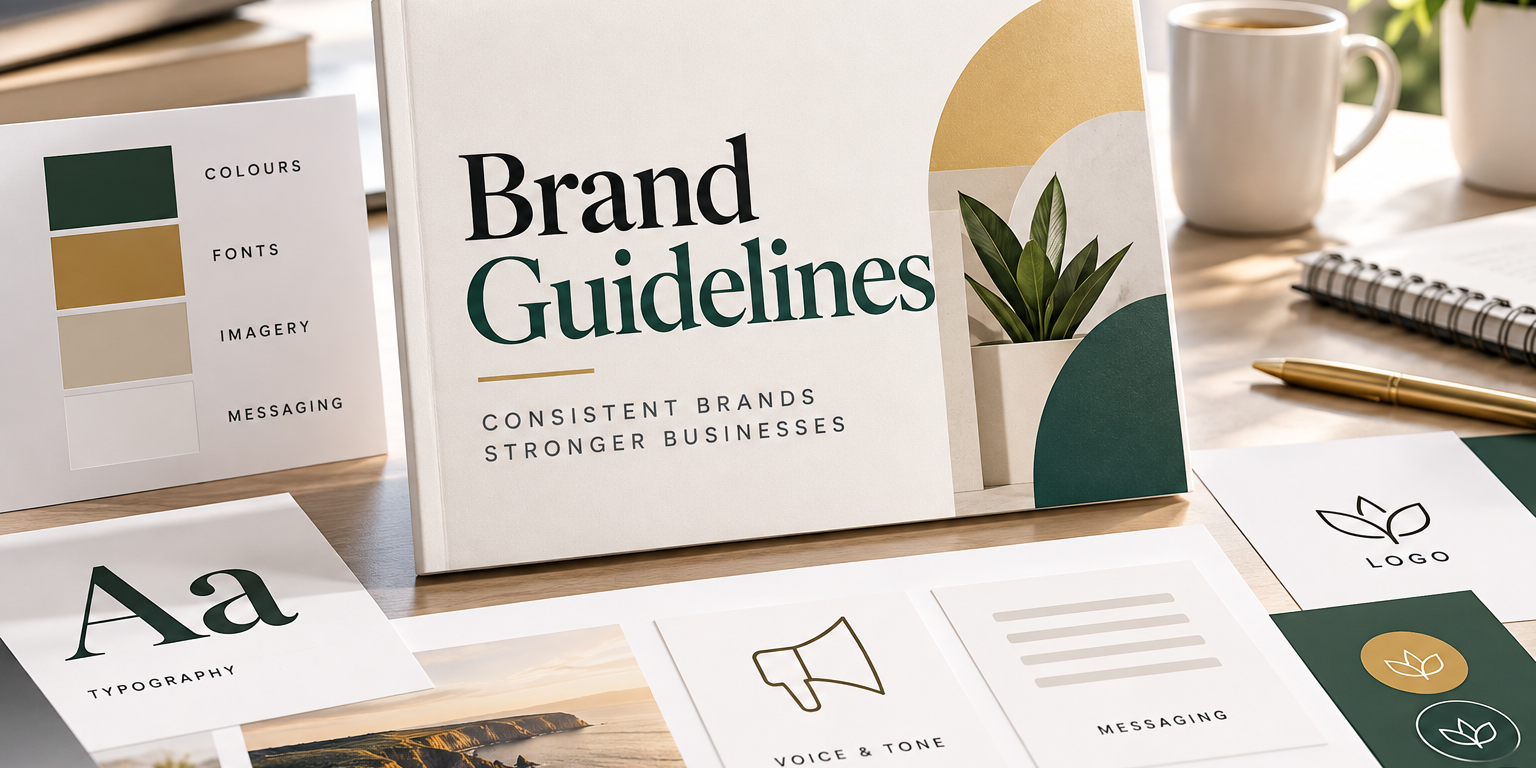
Brand guidelines are the rules that define how your logo, colours, fonts and messaging are used. They turn your brand identity from an idea into something anyone can follow correctly, without having to ask you every time.
Brand guidelines, style guides and brand books
These terms overlap, and different agencies use them differently. A style guide usually covers writing and design rules. A brand book often adds the brand story, values and personality. Brand guidelines are the practical rulebook that sits between the two. For most small businesses, one clear document that combines all of this is enough. What matters is not the name but whether people can find it, understand it and use it.
Why brand guidelines matter
- Consistency. Your website, social media, emails, print materials and signage look and sound like one business.
- Faster onboarding. New team members and freelancers can start work without a long briefing.
- Fewer revisions. Designers and writers get it right the first time because the rules are written down.
- Protection. Clear logo rules stop your most visible asset from being stretched, recoloured or cluttered.
- Better collaboration. Printers, web developers, agencies and partners all work from the same source.
- A professional impression. Consistent presentation signals that your business is organised and dependable.
What to include in your brand guidelines
- Brand story and purpose. A short paragraph on who you are, who you serve and why you exist, along with your value proposition and brand pillars.
- Logo rules. Primary, secondary and icon versions, the clear space around each one, minimum sizes, approved backgrounds and examples of what not to do, such as stretching, recolouring or adding effects.
- Colour palette. Primary and secondary colours with exact codes: HEX for screens, RGB for digital work and CMYK or Pantone for print. Note which colours are for backgrounds, text and buttons, and check that text colours have enough contrast to read easily.
- Typography. Fonts for headings and body text, preferred sizes and weights, fallback fonts for the web and where to download the files.
- Imagery. The style of photography, illustration and icons that fits your brand, what subjects to use, and whether stock images are acceptable.
- Voice and tone. Your brand voice traits, “we are / we are not” pairs and examples of tone shift by platform.
- Messaging. An approved business description in short, medium and long versions, your tagline, key phrases and words you avoid.
- Templates and layouts. Social post designs, email signatures, presentation slides, letterhead and proposal formats.
- Do and don’t examples. Side-by-side comparisons teach faster than paragraphs of rules.
- Contacts and approvals. Who owns the guidelines, who approves exceptions and where the master files are stored.
How long should brand guidelines be?
For most small businesses, five to ten pages is plenty. If you are just starting, create a one-page cheat sheet with your logo, colours, fonts, voice traits and business description, then expand it as you grow. A short document that people use beats a long one that nobody opens.
How to create your brand guidelines, step by step
- Audit what exists. Gather your website, social profiles, brochures, proposals, invoices and signage. Note where things differ.
- Make decisions. For each element, choose one standard version and retire the rest.
- Draft it in a simple tool. Google Docs, Canva or a PDF is fine. You do not need specialist software.
- Add real examples. Show approved logo placements, sample social posts and before-and-after comparisons.
- Test it. Ask someone unfamiliar with your business to create a simple social post using only the guidelines. Where they get stuck is where the document needs work.
- Share and store it in one place. Include downloadable logo files, colour codes and fonts so nobody has to hunt for them.
- Brief your team. A fifteen-minute walkthrough prevents months of inconsistent content.
How to make sure people actually use them
Guidelines only work if following them is easier than ignoring them. Keep the document short and visual. Build ready-to-use templates for the things you create most often. Assign one owner who answers questions and approves exceptions. Add a brief checklist to your content approval process, such as “Correct logo? Approved colours? Sounds like us?”
When to update your brand guidelines
Review them once a year and after major changes such as a new service, a new audience or a website redesign. Add a version number and date so everyone knows they have the latest copy, and remove old versions from shared folders.
Common brand guideline mistakes
- Making them too long. Nobody reads a forty-page document when they need a hex code.
- Only covering visuals. Voice and messaging need rules too.
- Giving rules without reasons. People follow guidance better when they understand why it exists.
- Hiding the file. If it takes ten minutes to find, it will not be used.
- Writing rules the business does not follow. Guidelines should describe how you actually communicate, improved, not a fantasy.
- Never updating them. Outdated guidelines are almost as unhelpful as none.
Frequently asked questions
Does a small business need brand guidelines? Yes. Even a one-page version prevents confusion and saves time every time someone creates content for you.
Who should own the guidelines? One named person, usually the owner or whoever manages marketing. Shared ownership often means no ownership.
Can I create brand guidelines without a designer? Yes, for many parts such as voice, messaging and basic usage rules. A designer is helpful for logo, colour and typography decisions, which the guidelines then record.
Where to go next
Brand guidelines record decisions made elsewhere, so read them alongside brand identity, brand voice, brand pillars and tone shift.
Need guidelines your whole team will actually use? Talk to us or browse the Marketing Terms Glossary.