Your business may rank on Google, receive website traffic and have active social media profiles. But would it appear if a potential customer asked ChatGPT, Gemini, Perplexity or Google’s AI features to recommend a business like yours?
That is the question an AI visibility audit is designed to explore.
Search behaviour is changing. People are no longer relying only on short keyword searches and lists of blue links. They are asking detailed questions, comparing providers and requesting recommendations through AI-powered tools. These systems may form an answer using information from your website, search indexes, business profiles, reviews, directories and independent sources across the web.
If those signals are incomplete, inconsistent or difficult to understand, your business may be overlooked or described inaccurately. An AI visibility audit helps identify those gaps and determine what should be improved.
What Is an AI Visibility Audit?
An AI visibility audit is a structured review of how discoverable, understandable and credible a business appears across traditional search and AI-generated search experiences.
It goes beyond asking whether your website ranks for a particular keyword. It examines whether the wider digital presence of the business gives search engines and AI tools enough clear, consistent evidence to recognise:
- Who the business is
- What services it provides
- Who it serves
- Where it operates
- What expertise it has
- Why it should be considered a credible source
- How a potential customer can take the next step
The purpose is not to chase a guaranteed AI ranking. No ethical provider can promise that a particular platform will cite or recommend a business. The purpose is to strengthen the information and signals those systems can access while improving the experience for human visitors at the same time.
Why Traditional SEO Is Still Part of the Audit
AI visibility is sometimes presented as a complete replacement for SEO. That is misleading.
Google states that its established SEO best practices remain relevant to AI Overviews and AI Mode. A page must be indexed and eligible to appear in Google Search before it can be shown as a supporting link in those AI features. Google also says there is no special schema or separate machine-readable file required solely for inclusion.
In practical terms, technical SEO, useful content, internal links, structured data that matches the visible page, page experience and accurate business information still matter. An AI visibility audit builds on those foundations and then looks at the additional question: can AI-powered systems confidently use and present what they find?
What Does an AI Visibility Audit Examine?
1. How Your Business Appears in AI-Generated Answers
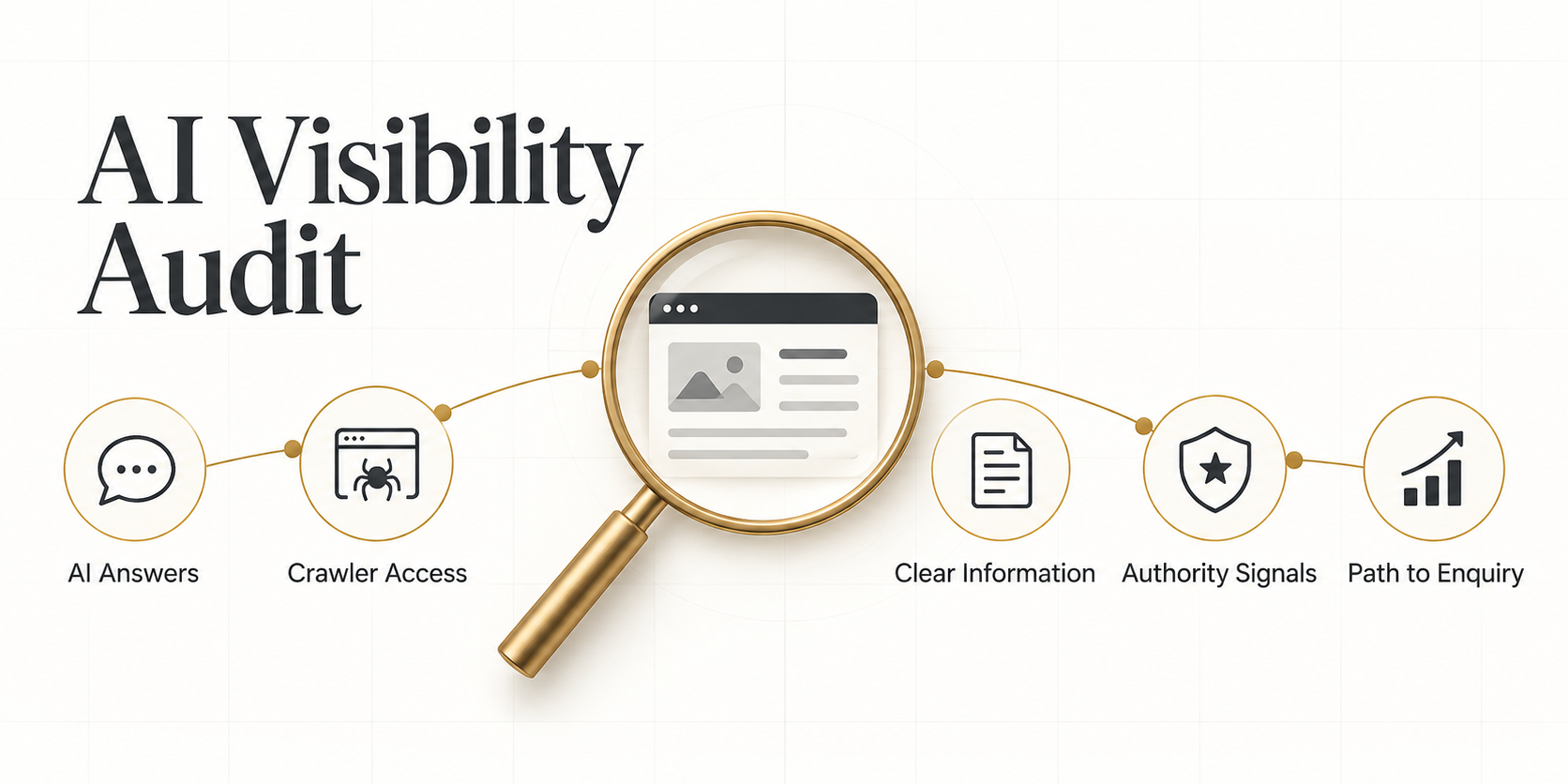
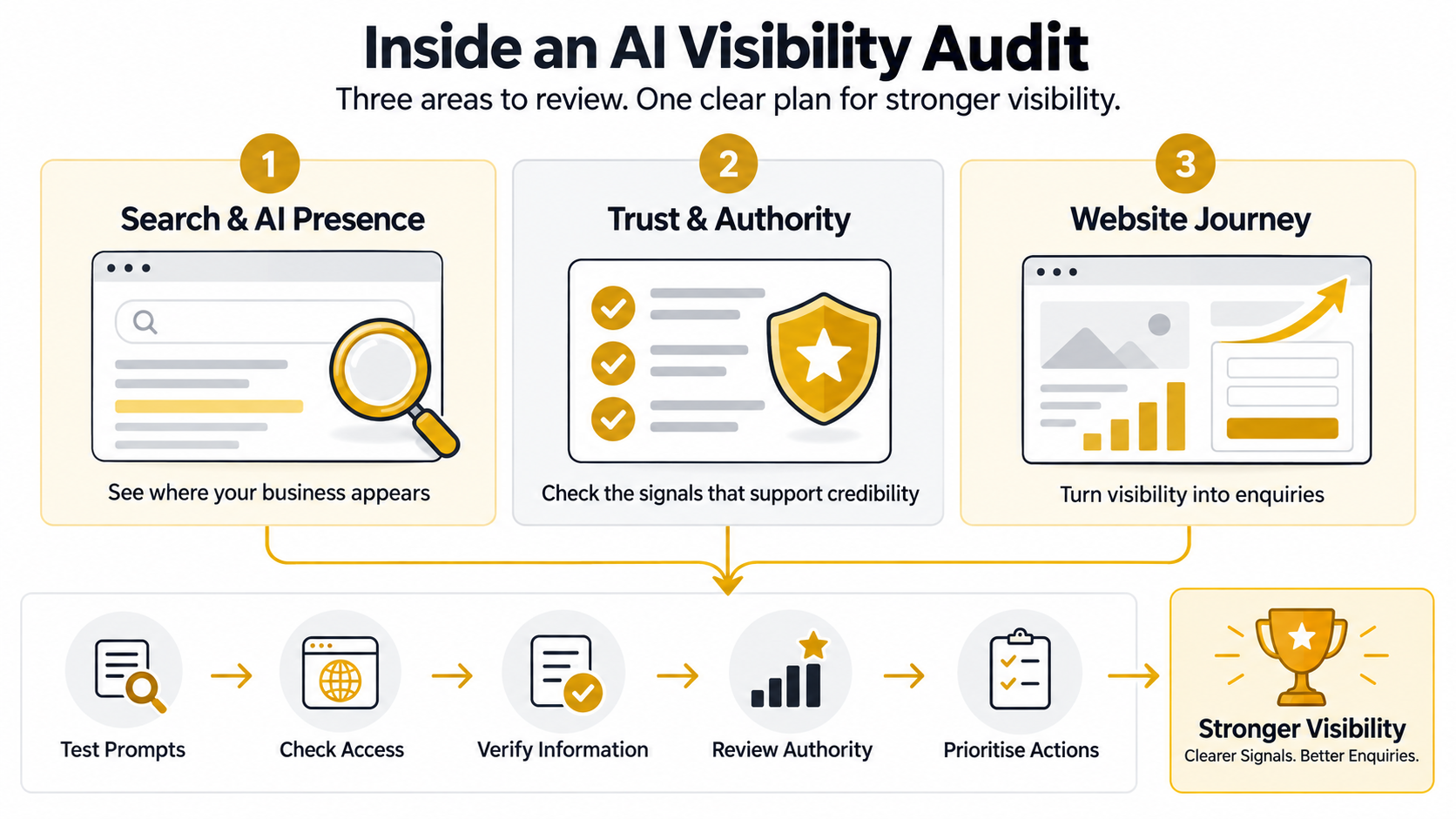
The audit tests realistic prompts that reflect how potential customers research services. This should include branded prompts, service-based questions, location-based searches, comparison questions and problem-led queries. The goal is to see whether the business appears, how it is described, which competitors are mentioned and what sources support the answer. Because AI responses can change, these tests provide a snapshot rather than a permanent score.
2. Whether Crawlers Can Access Important Content
A strong page cannot be cited if the relevant system cannot access it. The audit reviews robots.txt, indexing controls, firewall rules and other technical barriers. OpenAI advises publishers who want their content surfaced and cited in ChatGPT search to allow OAI-SearchBot. Perplexity similarly documents PerplexityBot for discovering and linking websites in its search results. These search crawlers should also be distinguished from controls relating to model training.
3. Whether Your Business Information Is Consistent
AI tools may encounter information about a business in many places. The audit checks whether the company name, address, contact details, service descriptions, locations, leadership information and areas of expertise agree across the website, business profiles, directories and other reputable sources. Conflicting information makes it harder for both people and machines to form a reliable picture.
4. Whether Your Content Is Citation-Ready
Citation-ready content answers a real question clearly, provides enough context to stand on its own and demonstrates why the information should be trusted. The audit looks for direct answers, descriptive headings, supporting evidence, identifiable authorship, meaningful examples and appropriate links to reliable sources. It also looks for vague, repetitive or generic content that adds little value.
5. Your Authority and Reputation Signals
A business cannot establish credibility through its own claims alone. An audit considers reviews, relevant third-party mentions, professional profiles, partnerships, awards, local citations and other independent evidence. The goal is not to manufacture authority. It is to make genuine experience and reputation easier to verify.
6. Website Structure and Structured Data
The audit reviews whether important services are easy to find, pages are connected through logical internal links and key information is available in readable text. It also checks whether appropriate structured data accurately reflects what visitors can see. Structured data can help search engines understand page information, but it should never be used to make claims that the visible content does not support.
7. The Journey From Visibility to Enquiry
Appearing in an AI answer has limited value if the next step is confusing. The audit therefore considers whether visitors can quickly understand the service, see evidence of trust and make contact. Calls to action, mobile usability, form length, contact information and follow-up systems all affect whether visibility becomes a genuine business opportunity.
What Questions Should the Audit Test?
A useful audit should test the kinds of questions a customer might genuinely ask, rather than searching only for the business name. Examples include:
- Who provides [service] in [location]?
- What should I look for when choosing a [type of provider]?
- Which companies specialise in [specific need]?
- What are the best options for [problem or desired outcome]?
- What does [business name] do?
- Is [business name] experienced in [specific service]?
The prompts should reflect different stages of the customer journey. Someone may begin with a broad question, narrow the options, compare providers and then check the reputation of a specific company.
AI Visibility Audit
Does Your Business Need an AI Visibility Audit?
An audit may be particularly valuable if:
- Your business relies on referrals, but referred prospects research you online before making contact
- Your website ranks for some searches but produces fewer enquiries than expected
- AI tools provide incomplete or inaccurate information about your company
- Competitors appear in AI recommendations while your business does not
- Your website contains years of overlapping, outdated or inconsistent content
- Your business has changed its services, locations, leadership or positioning
- You are investing in content without knowing whether it supports search visibility or conversion
- You want a clear baseline before investing in AEO or GEO work
It can also be useful for established businesses with strong offline reputations. Experience that is obvious to customers and colleagues may not be clearly documented online. An audit can reveal the gap between the reputation the business has earned and the evidence available to digital systems.
What Should You Receive After the Audit?
A good audit should produce more than a score or a long list of technical observations. It should give the business a prioritised plan.
That plan may include:
- A baseline of current visibility across selected search and AI platforms
- Examples of accurate, missing or misleading business information
- Technical issues affecting crawling or indexation
- Content gaps based on genuine customer questions
- Pages that should be improved, consolidated or created
- Reputation and third-party authority opportunities
- Improvements to the website’s enquiry journey
- A measurement plan covering visibility, referral traffic and conversions
Recommendations should be ranked by likely impact, urgency and effort. A small business does not need a list of fifty disconnected actions. It needs to know which few changes are most likely to improve clarity, credibility and commercial results.
What an AI Visibility Audit Cannot Promise
AI-generated responses are dynamic. They can vary by platform, wording, location, personalisation, available sources and time. An audit cannot guarantee that a business will be mentioned for every prompt or remain in the same position.
It should also avoid pretending that visibility comes from adding a few fashionable terms to existing pages. Sustainable improvement usually requires coordinated work across technical SEO, content, reputation, entity consistency and conversion.
The most useful outcome is not a promise of instant AI dominance. It is a more accurate, authoritative and helpful digital presence that serves customers wherever they search.
How Often Should You Review AI Visibility?
Begin with a baseline audit, implement the highest-priority changes and then monitor the prompts and platforms that matter most to the business. A fuller review may be appropriate quarterly or after a major website, service or brand change. Lightweight monthly checks can identify important shifts without turning monitoring into an unproductive daily exercise.
Measurement should also connect visibility with business outcomes. Track relevant search performance, ChatGPT and other referral traffic where available, conversions, branded searches, review activity and the quality of enquiries. Being mentioned is useful. Being mentioned accurately and attracting the right customer is more valuable.
The Bigger Question
An AI visibility audit is ultimately about more than AI.
It asks whether the digital version of your business reflects the real one. Is your expertise clearly explained? Is your reputation supported? Is your information accurate? Can a potential customer understand why you may be the right choice?
These questions matter whether someone finds you through Google, an AI assistant, a directory, social media or a personal referral.
| Is your business visible where customers are searching now?
Strategic Results Marketing can help you assess how your business appears across search engines, AI tools and the wider digital landscape. Book a visibility audit to identify what is working, where information or opportunities are being lost and what to prioritise next. |
Resources
Google Search Central: AI Features and Your Website
Google Search Central: Guide to Optimising for Generative AI Features