
KPIs, or key performance indicators, are specific measures used to evaluate progress towards an important business objective.
They help leaders move beyond instinct and activity reports by showing whether the organisation is achieving the outcomes that matter.
The word “key” is important. A business can track hundreds of numbers, but only a small number should be treated as KPIs. The right indicators focus attention on performance that is directly connected to the strategy.
KPIs Versus Metrics
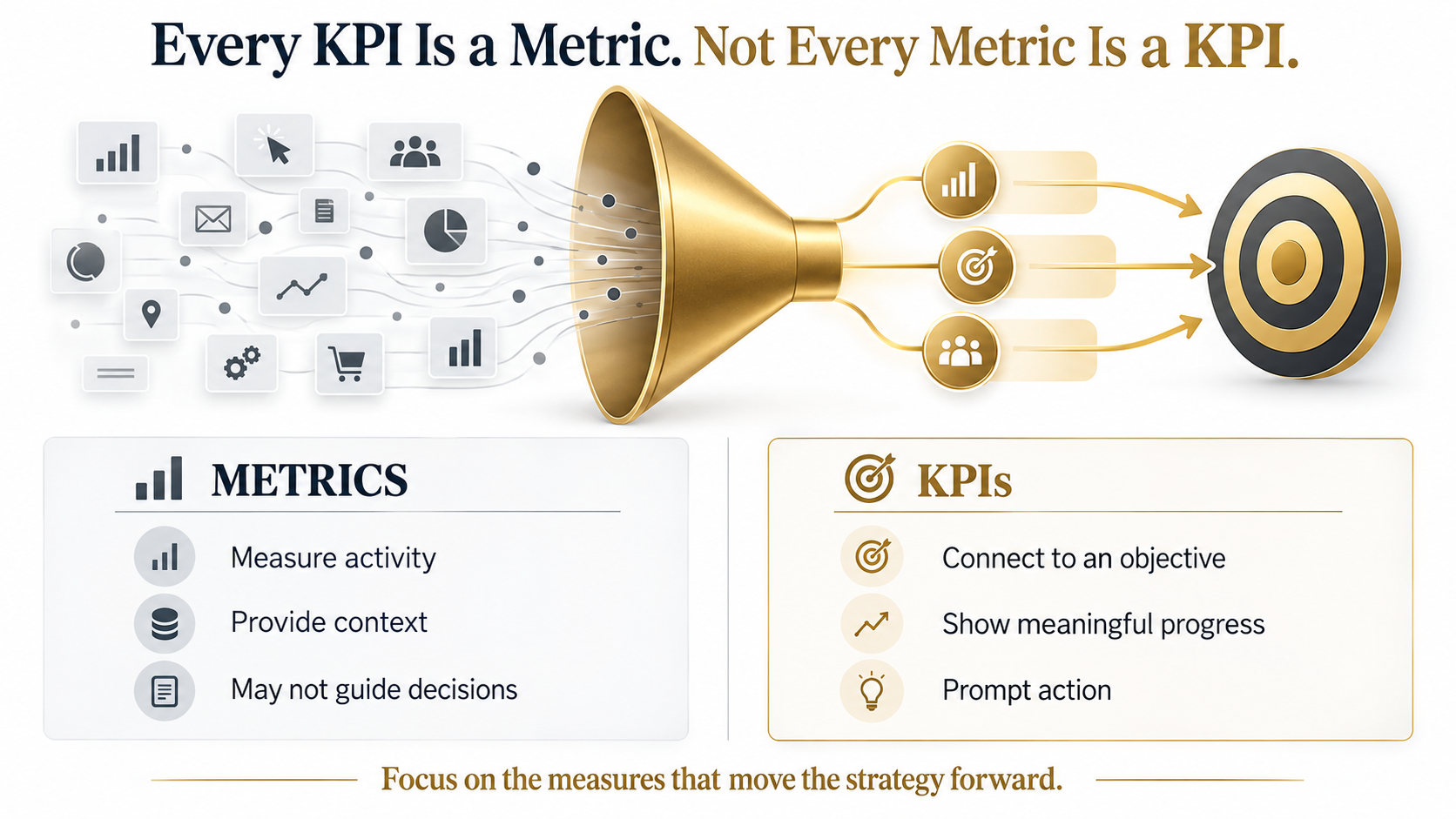
Every KPI is a metric, but not every metric is a KPI.
A metric is any measurable data point. Website visits, email opens, social media followers and page views are all metrics.
A KPI is a measure that indicates progress towards a defined objective. If the objective is to generate more qualified sales opportunities, the number of relevant enquiries and their conversion rate may be KPIs. Total website traffic may provide useful context, but it is not necessarily a key indicator.
This distinction helps businesses avoid reporting large volumes of data without gaining meaningful insight.
What Makes a Good KPI?
A useful KPI should be:
- Connected to a clear objective
- Specific and measurable
- Relevant to business performance
- Based on reliable data
- Reviewed at an appropriate frequency
- Understood by the people responsible for influencing it
- Capable of prompting a decision or action
If a number changes but nobody knows what to do differently, it may not be an effective KPI.
 Examples of Business KPIs
The right indicators depend on the company’s strategy and goals. Common examples include:
Financial KPIs
- Revenue growth
- Gross profit margin
- Recurring revenue
- Average customer value
- Cash conversion cycle
Customer KPIs
- Customer retention rate
- Repeat purchase rate
- Customer satisfaction
- Referral rate
- Customer lifetime value
Operational KPIs
- Delivery time
- Capacity utilisation
- Error or rework rate
- Project profitability
- Employee retention
Sales KPIs
- Qualified opportunities
- Proposal-to-sale conversion rate
- Average sales cycle
- Win rate
- Revenue by service or market segment
Marketing KPIs That Connect to Business Results
Marketing measurement often becomes crowded with surface-level numbers. Reach, impressions and engagement can be useful, but they need context.
More commercially meaningful marketing KPIs may include:
- Qualified leads generated
- Cost per qualified lead
- Lead-to-customer conversion rate
- Revenue influenced by marketing
- Organic enquiries
- Visibility for high-intent search topics
- Email-generated enquiries or sales
- Customer acquisition cost
- Return on marketing investment
For businesses investing in online visibility, it may also be useful to monitor branded searches, review growth, referral traffic, search citations and whether the company appears in relevant AI-generated answers. These measures should still be connected to a wider objective rather than tracked simply because the data is available.
Leading and Lagging Indicators
KPIs can be divided into leading and lagging indicators.
Lagging indicators show what has already happened. Revenue, profit and customer retention are examples. They are important, but by the time they change, the underlying activity has already taken place.
Leading indicators provide an earlier signal of future performance. Sales conversations, qualified enquiries, proposal activity and customer engagement may indicate what is likely to happen next.
A useful KPI framework includes both. Lagging indicators confirm results, while leading indicators help a business act before those final results are known.
Avoiding KPI Overload
Tracking too many KPIs weakens focus. Leadership teams can become absorbed in reporting while missing the few numbers that genuinely signal progress.
Start with each major business objective and ask: what evidence would show that we are succeeding?
For every KPI, define:
- What is being measured?
- Why does it matter?
- Where does the data come from?
- Who owns the result?
- How often will it be reviewed?
- What action will follow if performance is above or below target?